
We often ask the question, what’s the big deal about coffee competitions? And why do coffee professionals get sucked so deep into this vortex? We asked a non-coffee professional who has found herself thrust (voluntarily) into this top echelon of the coffee world, to try make sense of it all for coffee lovers. And as a new competition cycle kicks off and a new Devil Wears Prada is almost on screen, it seemed a good time to share this piece originally published in Issue 47.
Words by Nicole Siegenthaler
Approximately ten Internet years (three real life months) ago TikTok posed the question: What’s your Roman Empire? The ‘Roman Empire’ trend caught fire as women asked their partners ‘How often do you think about the Roman Empire?’ Quite often, it turned out. Collectively shocked, women of the Internet turned around and asked themselves, what seemingly random thing is it that I think about on a daily basis? Reader, despite the fact that exactly none of you asked, I’m delighted to take this time with you to discuss one of my many Roman Empires: coffee competition. Specifically, Barista Championships.
Admittedly, I came around to the competition scene quite reluctantly. I watched my first competition in late 2021, over livestream: the World Barista Championships in Milan. My new friends visiting from Indonesia, Muhammad Aga and Resiani Triane wanted to watch and support the Indonesian competitor Mikael Jasin. At the time, although I was an enthusiastic consumer of specialty coffee, most of it went over my head. The language to describe processing techniques, the origins and particular locations and elevations of the farms, the specification of a mandarin orange flavour note versus tangerine – what did it all actually matter in my cup of coffee? Little did I know that in the next two years I’d spend many hours coaching Aga in competition, judge alongside Resi and have the privilege to judge Miky on the national stage.
What is a barista competition?
Before I get ahead of myself, let’s lay some groundwork. What is a barista competition? Overseen by the Specialty Coffee Association (SCA), in the World Barista Championship and its subsidiary national qualifying events, a barista has fifteen minutes to prepare four sensory judges each three drink courses: an espresso, a milk beverage and a signature beverage. Twelve drinks in fifteen minutes, you perhaps are seeing why 2021 me was sceptical of this song and dance. To add further intrigue, the barista is expected to give a speech while furiously working and serving that should somehow inspire, illuminate or at least celebrate the craft of specialty coffee. It is, frankly, an absurd feat.
Joining competition
In May of 2022 I had temporarily relocated to Jakarta. Aga wasted no time in recruiting me to his coaching team for that year’s Indonesia Barista Championship – he had previously won in 2018 and was hungry to reclaim the title. Reader, if you are confused why a seasoned champ would want a complete muggle on their team, you are not alone – I protested my participation for the first month of practice as I begrudgingly watched him put in reps on the espresso machine. He assured me my finesse of the English language and propensity for storytelling would make me a valuable asset in his concept building and script writing. Eventually, I relented and dove into the world of barista competition head first.
That first season with Aga was a learning curve for me as I quickly levelled up not just my coffee knowledge but also my comprehension of competition rules and structure. After turning over many concept directions with Aga and reading the thirty eight page rules over multiple times I nervously completed and presented my first draft of his script. He gamely read the entire document through before gently pointing out: this will take thirty minutes to do on stage. This brings me to the first beauty of competition: through challenges and restrictions we find innovation.
Per aspera ad astra
In my defence of that epic six page long first draft of a script: brevity was never my forté. Unfortunately, given the strict fifteen minute time frame of barista competition coupled with the fact that Aga would be busy with his workflow, we obviously would need to edit down. We also quickly realised that my propensity for language would not necessarily land on the noisy competition stage with judges who were not native English speakers. And so, the editing began.
One of my favourite concepts for creatives is ‘don’t be afraid to kill your darlings’ meaning, don’t get too attached to your ideas. Both years I’ve worked with Aga on his scripts there have been pages upon pages that have been deleted, re-arranged, cut up and eventually abandoned. The fifteen minute timeframe and dynamic nature of the competition stage meant we needed to sharpen and distil our concept and his service to its absolute essential pure form. I am incredibly proud of what we landed on that first year: ‘Good coffee is for everyone.’ While he had years of experience in the industry, he was tired of the gatekeeping and perceived (and real) snobbery in specialty coffee. As a noob to the competition field, I was incredibly intimidated by the language, knowledge and palettes of our fellow competitors. ‘Good coffee is for everyone’ was a simple call to action we quickly united under.
That first year, Aga competed with a beautiful Ethiopian coffee as well as an Indonesian Liberica. At the time Liberica was readily available in the region (especially from Malaysia) though undervalued as it had the stereotype of tasting smoky or woody, or at best perhaps like jackfruit (the varietal is high in sugar content making roasting and processing a bit precarious). In the spirit of ‘Good coffee is for everyone’ Aga wanted to demonstrate that you didn’t need to spend a fortune on competition coffee, and certainly didn’t need to be drinking a prized Eugenioides or Geisha in order to have a good time. Working carefully on the roast and post harvest processing he was able to present a beautiful milk beverage with the Liberica. In the same way I was restricted by a fifteen minute performance limit for my script drafts, he applied the restriction of budget in order to lean into creativity and resourcefulness – ultimately arriving at a delicious, original beverage.
While the time limits and other rules of competition are certainly challenging, the other side of that same coin is the possibilities they present. And realistically how often in life are we presented with ideal conditions? Coaching barista competition has reminded me that these budget, physical, logistical or even diplomatic challenges can be seen as a hindrance or a call to action towards innovation. The choice is ours.
Barista judging: a humbling, illuminating platform
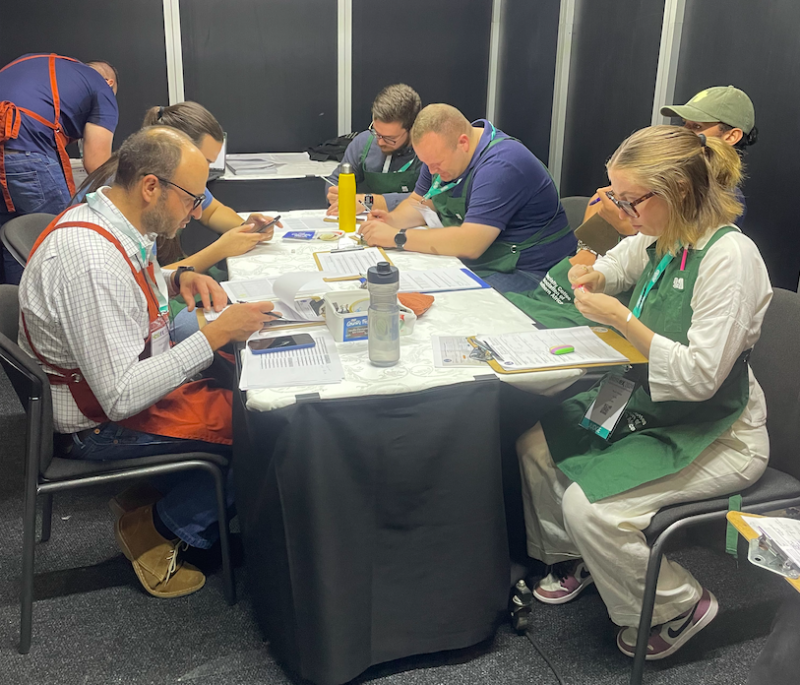
After surviving my first round of barista comp as a coach I thought I better learn the other side of the table as a judge. For barista competition there are a set of sensory judges that taste and evaluate the coffee and performance and a set of technical judges who scrutinise the workflow and cleanliness of the barista at their station. Given my last run on an espresso machine with any regularity was from 2005 to 2007 at my local Starbucks back in the States, the decision to join training as a sensory judge was basically made for me.
Inspired by my friend Resi with whom I watched that first competition run back in 2021, a woman who judges what feels like every other barista competition in Indonesia, I have thrown myself into every judging opportunity. The beauty of judging is it is 100%, irrevocably rule based – the SCA drafts and annually updates the competition rules to reflect industry trends, spirit and of course health standards. Our job as judges is to compare the performance to the rules and evaluate. While this is straightforward enough, it is not easy (especially for sensory judges who may drink anywhere from five to upwards of fifteen espressos in a full day of judging). The mental fatigue in distinguishing flavours (my SCA rep in Indonesia reminded us during calibration that simply noting ‘mango’ was not enough as in South East Asia there are over thirty-two varieties and therefore flavour profiles of mango), scoring the experience and then articulating into (rule based) comments on our score sheets is mentally exhausting. It also often ends up being very stressful as we integrate each set, score and comment we give.
However, through all of these anxieties I have come to embrace the experience of judging for pushing me out of my comfort zone. As adults I believe we find very few opportunities to truly be humbled – while I don’t particularly wish to return to my teenage days, there was something about being required to try each sport during gym class regardless if I understood the physics of a baseball bat or not, or having to respond to my French teacher in full French sentences in front of my peers on the spot. On one hand, if I failed spectacularly it was affirming to see that life went on. However, if I simply made it through it was doubly affirming to see that I could take on a scary situation when put on the spot. Now as an adult, judging barista competition has been a scary, but welcomed challenge.
This year (2024 at the time) our SCA representative for South Africa Nationals, Nina Rimpl, shared that she approaches each competition as if it’s her first – there are no preconceived notions about how a competitor or coffee will perform. This reminder affirmed the anxieties I’ve felt before each competition: we absolutely *should* be re-reading the rules, staying sharp on our senses and palettes in order to continue judging fairly. Rules and trends change year to year so it is important for judges to be continuously re-evaluating their palettes and knowledge. For me, judging barista competition is a unique opportunity that while perhaps not as savage as a high school lunchroom, is certainly just as dynamic.
A word on exclusivity
I admit my arguments for the merits of participating in a barista competition (“you will face challenges that force you to make a plan B, C and D” and “you will be deeply out of your comfort zone”) are not particularly inspiring at face value. As long as we are now speaking honestly we should also address the elephant in the room concerning competition: the exclusivity and resources needed to compete.
Barista competition sets typically use very expensive, difficult to source coffees. The presentations usually include technical jargon about fermentation, processing and roasting that would go well above the regular coffee consumer. If we really take a step back, the idea of being asked to look for ‘notes of guava with a jasmine tea finish’ inside an espresso does come across as, well, silly.
Let’s call a spade a spade: yes, competitions are pretentious spaces that generally require a good amount of financial resources and time (another type of financial resource) to participate in. However this brings me to another one of my personal Roman Empires: Meryl Streep.
Cerulean
In the 2006 classic ‘The Devil Wears Prada’ Meryl Streep plays Miranda Priestly, an editor-in-chief Anna Wintour-esque monster boss at a major fashion publication. Twenty four seven all day every day she antagonises her assistant, our heroine Andy (Anne Hathaway) who quite frankly is just trying to pay her bills and couldn’t care about this silly fuss over the fashion crap, thank-you-very-much. In one tense scene, Andy is assisting Priestly and senior staff in pulling looks for an upcoming issue with Priestly trying to decide between two (admittedly very similar looking) blue belts.
When Andy giggles under her breath at the absurdity of the drama of the decision, Priestley asks if something is funny – Andy admits sheepishly that the belts “look exactly the same to me.” With not so much as a lift of an eyebrow Streep delivers a monologue which undoubtedly sealed the deal for her Best Actress Oscar win that year: explaining that while Andy may “think this has nothing to do with you” that actually the ‘blue’ of her sweater she is wearing that day “is not just blue, it’s not turquoise, it’s not lapis, it’s actually cerulean.” She continues to list off designers that used cerulean in their runway collections in past years, then points out “then it filtered down through the department stores” before Andy “fished it out of some clearance bin” and finishes her attack by asserting “however, that ‘blue’ represents millions of dollars of countless jobs, and it’s sort of comical how you think that you’ve made a choice that exempts you from the fashion industry when, in fact, you’re wearing a sweater that was selected for you by the people in this room.”
After we move past the clear judgement and disdain Streep’s character projects onto her assistant, this scene is a very profound reminder on the responsibility and power that industry leaders and platforms have in their fields. And here is our bridge back to the coffee industry where I will reaffirm: yes, competitions are very exclusive spaces.
However, they are also the launching grounds of new techniques and innovations for cafes worldwide. After Aga used Liberica in his 2022 routine, it has been used widely in other routines in the country and is now beginning to show up on shelves in Indonesian coffee shops. Given the fact that Liberica can grow at very low elevations (even at sea level) it has the potential to be an appealing crop of the future as climate change reduces the already scarce growing regions of higher altitude Arabica and Robusta farms. It also remains one of my personal favourites with milk, typically creating a warm complexity not often found in your standard cappuccino.
Collectively considered: it’s not a stretch to imagine that that one routine had the power to both provide a solution to climate change threats on the coffee farming industry and deliver customers a more delicious cup of coffee. And indeed that’s why barista competitions are my Roman Empire.