
Always Be Prepared
The evolution of puck preparation in the Quest for Better Espresso
Words by Phaedon Gourtsoyannis, founder and owner of Cape Coffee Beans
Tools are designed to make your coffee better, although this doesn’t always mean that it will be simple. Never fear, there’s no need to be overwhelmed. Phaedon Gourtsoyannis, owner and Founder of Cape Coffee Beans, the go-to for coffee gadgets, unpacks the way distribution tools have helped make espresso better and why you should consider investing in one.
Over the last decade or two, the way people make espresso, particularly in the home setting and in specialty cafes, has become more elaborate. The traditional image we have of a barista grinding, tamping, and locking their portafilter into the espresso machine has been embellished. Additional steps include the use of accessories like scales, collars, and perhaps most notably distribution tools. Pulling shots looks a lot more complicated than it used to. ‘Puck prep’, as it’s come to be called, has become a big focus for meticulous baristas, as well as for equipment manufacturers.
A casual observer may wonder what these extra steps are about, and whether they really matter. One might also wonder if any of these extra tools are actually necessary. In this piece, we’d like to address some of these questions, with a focus on the different types of tools for distribution out there, and why you might want to have one.
The problem is channelling
Before looking at the tools, it makes sense to start by understanding the problem they are trying to solve. That problem is channelling. Without getting too far down the fluid dynamics rabbit-hole, the basic science is that water likes to follow the path of least resistance, particularly when under high pressure. An espresso puck is tightly tamped, finely ground coffee and the water coming from the grouphead at 9-bars of pressure will naturally find the least dense parts of the puck and flow more readily through them.
This phenomenon, called channelling, leads to an unfortunate combination of over-extraction (where there is more water flow) and under-extraction (where there is less water flow). Most importantly for coffee lovers, it tends to make bad-tasting espresso. Some even say that much of what we attribute to over-extraction might actually be the result of channelling. Whether that’s entirely true or not, we can at least say that channelling is bad news for tasty espressos.
There are many techniques and technological innovations in coffee-making aimed at addressing this problem, from the very low tech (like tapping the portafilter) to the more sophisticated (like anti-clumping chutes designed for and implemented in high-end espresso grinders). They can also include things like puck screens, pre-infusion and precision shower screens. But let’s take one thing at a time. We’re going to focus on distribution tools.
Why should we focus on distribution?
The main cause of channelling is variation in the density of the espresso puck, even after tamping; one of the main contributors to this problem is uneven distribution of grounds in the portafilter, the natural result of the fact that the coffee that comes out of grinders is a bit ‘clumpy’. If your fluffy, freshly ground coffee includes clumps, and you just tamp it as it is, you may even exacerbate the problem of variation in puck density.
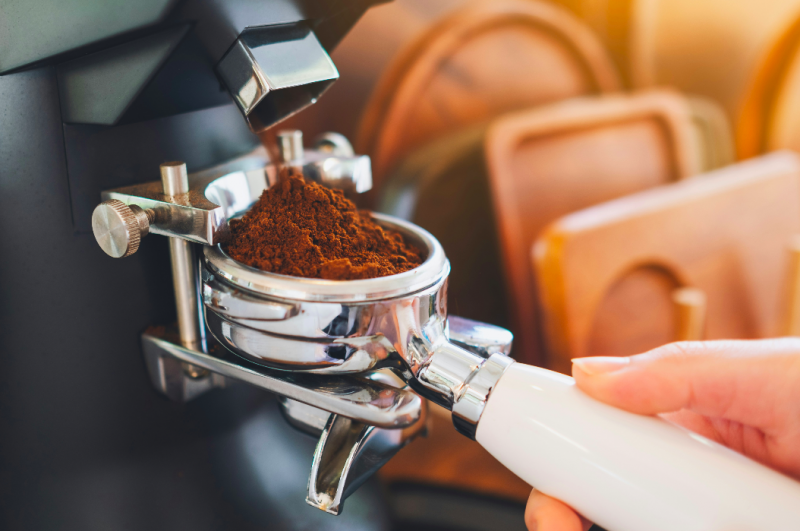
Good baristas have always known this, and tried to address it in any way they can. That’s why you may see some tapping the side of the portafilter with their hand, or using their fingers across top of the basket known as the Stockfleth Method, both of which try to solve the problem of uneven distribution manually. The challenge is, none of these manual methods are highly effective or consistent.
In recent years, a number of tools have been released to help with this problem, ranging from the simple to the more sophisticated, but all offering a step up from the basics of distributing by hand.
Dosing Cups
Some may quibble with the idea that dosing cups belong in this discussion; to be fair, dosing cups are not distribution tools. They serve a lot of purposes, including making it easier to keep your bar tidy and limit waste, but if you grind into a dosing cup, like this one from Pesado, and give the dose a good shake as it goes into the portafilter, you will invariably break up some clumps and improve your distribution. The only issue is that this isn’t highly repeatable and it’s certainly not perfectly effective. Nevertheless, it’s a step up from doing nothing at all about distribution, and it can be combined with some of the methods mentioned later in this article.
Wedge Distribution Tools
One of the most common accessories designed to help with distribution is a wedge distribution tool, also sometimes called a coffee leveller. You’re as likely to see these in a specialty cafe as you are on the counter of a perfectionist home barista. In basic terms, a wedge distribution tool is placed on the top of the portafilter that is filled with ground coffee and spun around (before tamping). Using specially shaped fins, it levels the coffee and redistributes it, preparing it for tamping.
While it’s not entirely clear who invented the very first distribution tool of this type, it’s fair to say that it was made popular by former World Barista Champion, Sasa Sestic. Originally released as the OCD (ONA Coffee Distributor) and since renamed the NCD (Nucleus Coffee Distributor), you could easily argue that Sestic’s take on the distributor, which is the result of years of R&D and several design tweaks, is the most recognisable and popular high-end tool. You will, in fact, see it on the counter in many cafes across South Africa.
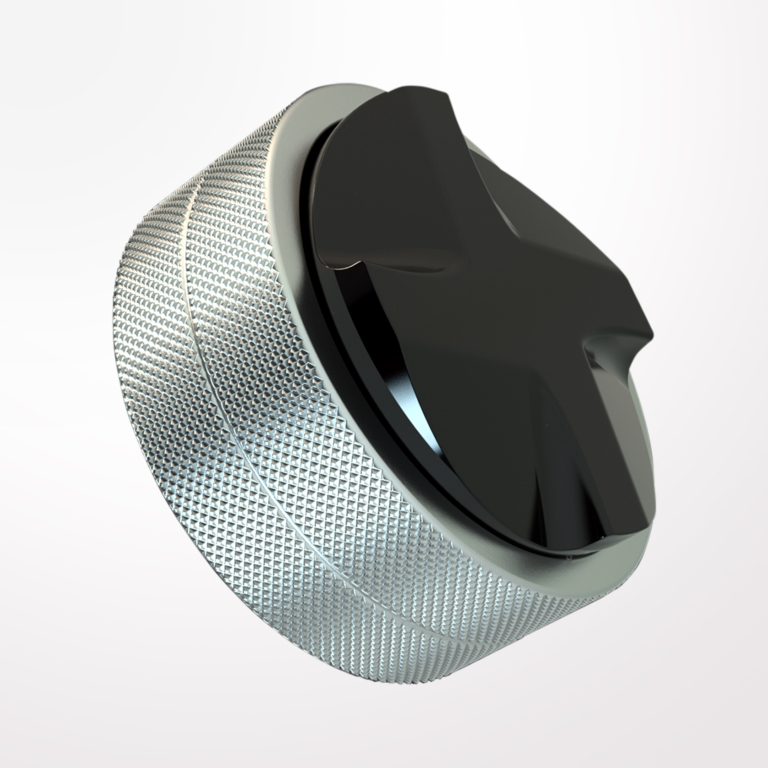
Some argue that this style of tool will only influence the top part of the puck as that’s where it exerts pressure. While this may be true, it should offer an additional step up in terms of distribution from anything we’ve mentioned so far, and it also has one clear advantage: it’s fast. An experienced barista can use a tool like the NCD in seconds with a few spins, making it a viable option even in a busy cafe, where some other tools may just slow down service too much.
WDT Tools
Not to be confused with the aforementioned Wedge Distribution Tools, WDT stands for the Weiss Distribution Technique. It is named after John Weiss, the man who pioneered and promulgated it in digital coffee forums before it became a commercial product category. The very first Weiss Distribution Tools were DIY jobs put together with items like acupuncture needles and corks, even guitar strings, as used by 2013 SA barista Champion, Craig Charity. But today, you’ll find a wide array of high-quality products emulating the original concept and design, such as Barista Hustle Tools’ Comb or Normcore’s WDT.
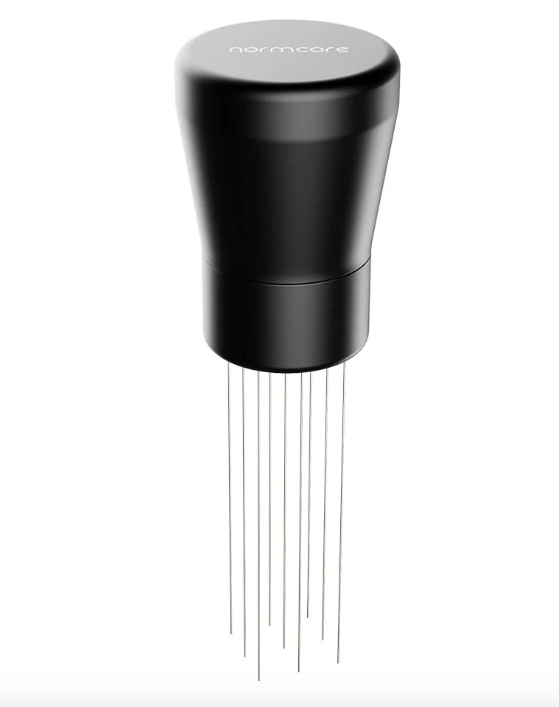
All WDTs do basically the same thing: they use needles to break up clumps and mix the coffee bed in a way that should yield perfectly distributed coffee (if perfectly executed). From a puck uniformity perspective, you could argue that this is the ultimate solution. Its challenges are the potential for messiness when you stir the coffee in the portafilter (somewhat helped by using a portafilter collar like BHT’s Ring) but also the time it takes to do it right. These challenges make WDT a less common approach in the commercial space, but a top choice for assiduous home espresso enthusiasts.
The AutoComb
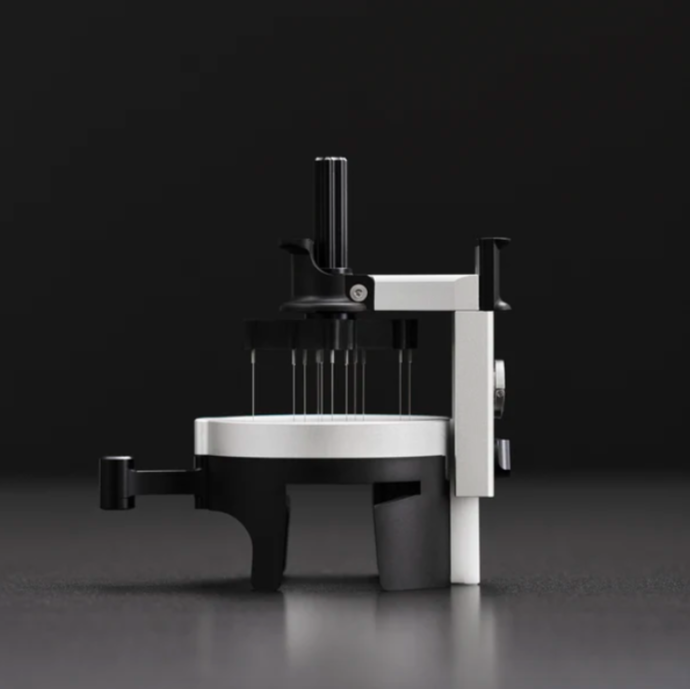
No article on distribution tools could neglect to mention the AutoComb from Barista Hustle Tools, even if it is difficult to place it in any category other than its own. This highly engineered piece of kit takes the idea behind the Weiss Distribution Technique and automates much of it in a way that addresses some of the shortcomings previously mentioned. By locking onto the portafilter and mounting the needles onto an axle that spins, baristas can get the benefits of WDT without the messiness or as much of a time investment. That’s probably why you see an AutoComb at many barista competitions around the world. The AutoComb’s only real shortcoming is that it’s pricey compared to the other solutions, but it is becoming more and more common in contexts where baristas are trying to perfect extractions.

So, which Distribution Method is best for you?
Having learned about some of the potential ways to distribute and tackle the challenge of channeling, you can now consider the best approach for you. Are you happy to just use the manual approach or do you want to invest in a tool that will ensure better distribution? You’ll need to balance your budget, both in terms of time and money. Your solution will need to reflect your particular setup and goals. You might decide that the good ol’ fashioned Stockfleth method with a bit of a tap of the portafilter is good enough for you. You may be the type of perfectionist that will grind into a dosing cup, use a WDT and an NCD before tamping (they are out there). The important thing to realise is that to make great espresso, you can’t neglect the potential extraction pitfall of channelling. That’s why distribution tools are becoming a feature of more espresso setups around the world and may just help you make tastier espresso-based drinks at home. If you’re investing in good quality coffee beans, it only makes sense to eliminate room for error and a distribution tool is a simple way to achieve this.