
Interview by Katie Burnett
Coffee travels far and wide to get to your cup. What starts a seed in the ground of an equatorial country, ends up in the mugs of consumers around the world. Of course, each individual coffee has its own supply chain, depending on the buyer (roaster or trader or exporter) , the seller (the producer, the exporter or the co-operative). However, most coffee follows a supply chain of producer, exporter, trader, roaster.
Coffee can be a fairly poorly understood product. How it gets from a farm in Rwanda to your cup in the middle of Johannesburg is an illusive topic for most of us. I sat down with Andrew Boltman, a coffee industry legend and one of the founders of Zuka Green Coffee, a green coffee trading company who is integral to specialty coffee that consumers have access to in South Africa.
What is your role at Zuka and subsequently, your role in the coffee supply chain?
I am one of the founders and directors of Zuka Green Coffee. As a director you are involved at some level in most areas, but what makes me personally come alive is a good spreadsheet, and being out in the trade drinking coffee with roasters. Zuka’s role in the supply chain is essential, as we bring the coffee from where it grows all over the world to the people that roast it and turn it into an enjoyable consumable product. We specialize on the trading side; so, not just sourcing, buying and transporting the coffee, but also managing the price risk via the Coffee Futures market and Forex cover.
How do you discover and go about initiating a relationship with a producer?
A good example: Our most recent new relationship is with a Costa Rica farming family, and we were introduced via a great coffee friend, Stephen Vick. Initiating new relationships happens in many different ways, but it’s best, and in a way safer, to be introduced by someone who already has worked in some way with the producer before.
Do you have a minimum amount of coffee you buy from each producer?
Not really. In the case of the Costa Rica farmer above, we only bought a few bags, but we managed to consolidate it with a bigger container already coming. We do however feel that the producer is the most important person in the chain, and it’s essential that their business makes sense, so with some of our other direct relationships we look to buy as much as we can from them, as much as makes sense for our market.
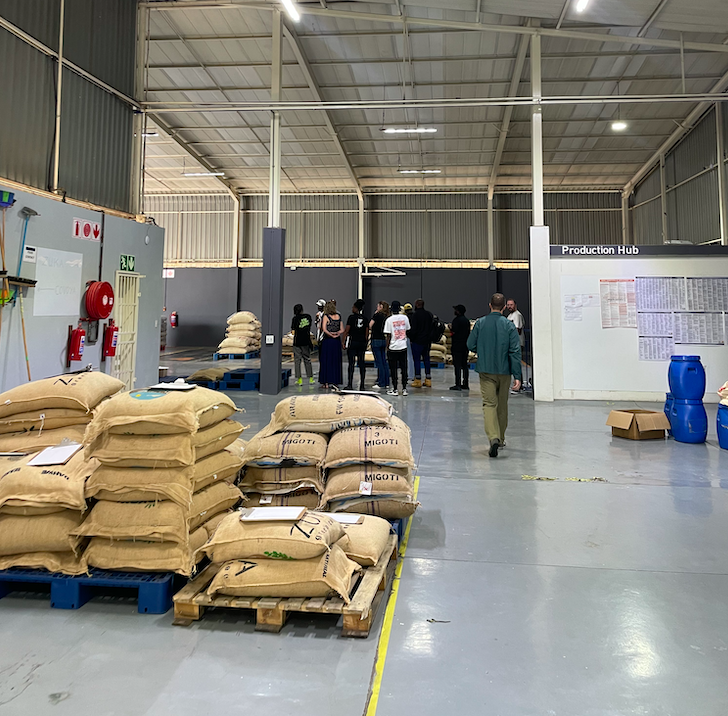
How does your coffee get from origin to your warehouse? Shipped or flown, in containers, on pallets.
We transport most of our coffee in containers via sea freight, using trucks to and from the ports. We have flown coffee in a few times, but airfreight is so expensive, and we try to be an economical as possible.
Is there a particular country or region that has been the most difficult to source coffee from, logistics-wise?
Our general culture at Zuka is to ‘make a plan’, so even with countries that have been more difficult, we have found a way and made it work. Landlocked countries take a lot more effort logistics wise, and it costs more to move the coffee, but we find a way in the end.
Do you first find customers(roasteries) for the coffee before securing supply from producers, or build a menu and then allow your customers to select from there?
A bit of both. I started and ran a roastery with good friends for 10 years before getting into green coffee, so I have a bit of an idea of what roasters are looking for in variety, especially specialty coffee. But sometimes, especially in testing the viability of something new, it’s best to try preselling some of the container and then ‘build a menu’, as you say, with the rest of the consignment.
Can you briefly describe the effect of the tumultuous commodity price on Zuka’s daily operations and how it has disrupted trading/the supply chain.
Briefly…… Last year (2025) was a very difficult year in the global coffee trade. Most of the world’s coffee is traded against the New York Coffee Futures price. This price broke through the all-time high of 1977 early in the year, and went up a further 30% to set a new all-time high price (to give context, the new price was over 4 times higher than the price in 2021). The price is mostly driven by speculation over future coffee harvests, Brazil’s harvest being the most important one to watch. I think the hardest part for us was the volatility of the coffee price. Most weeks it would move up or down sharply (mostly up). This made it very difficult to make decisions on when exactly to fix the prices of incoming shipments. In my experience though, it’s the coffee roasters who took the biggest knocks in the middle margin-wise, as it’s a highly competitive space, and so the end consumer saw a lot of the increases, but not all of it. That all being said, and at the time of writing this, it seems coffee pricing is settling in what seems might be a big incoming Brazil harvest. Let’s see.